
Polk County VINELink Coverage
Florida uses VINE and VINELink for custody information and notifications. PCSO links the service from its own Jail Information Search, confirming that VINE is the alert layer tied to Polk jail data. Statewide material also identifies participating county jails, Florida Department of Corrections prisons, and juvenile justice as sources. Each agency controls the event and fields it sends.
That scope makes the reporting agency vital. A PCSO card answers a Polk county-jail custody episode. An FDC card answers state custody. Florida VINE does not serve as the BOP Inmate Locator, ICE Online Detainee Locator, a court docket, or a full supervision database. A person leaving PCSO for FDC or another custodian may generate movement information without being free from custody.
- Custody event
- A reported change such as release, transfer, escape, death, or out-to-court movement.
- Out of custody
- The reporting agency's custody episode ended; it does not state every reason or destination.
- Transfer
- Movement to another facility or custodian, not necessarily community release.
- Notification
- An alert about supplied data, not the official release record itself.
Search a Polk VINELink Record
Open the Florida VINELink person search and work from an official spelling or identifier. A common name can return more than one person, so compare every available field. VINELink is best for a known person, not for building a list of all people released during a date range.
- Choose Florida and select Find or Search for a Person.
- Enter the person's name or the identifier option shown by the current interface.
- Compare available identifiers and open only the matching custody card.
- Read the reporting agency, facility, and custody status before interpreting the event.
- If no result appears, try an alias or spelling variation, then use the agency's own search.
A no-result does not prove the person was never held or has been released. It can reflect delay, source scope, display limits, a transfer, or restricted material. Use the Polk County released inmate search path to check the PCSO profile, Clerk docket, FDC record, or another custodian.
For a Polk jail match, first use PCSO Name Search with Current inmates only left unchecked. Open the booking number and note the booking date, release date, status, and any location. Those details help distinguish an old released booking from a later current booking for the same person. For an FDC match, use the DC number when known and compare the state photograph, birth date, release history, and institution. VINELink then adds the alert function to an identity already grounded in an agency record.
The official Florida person-search screen is the page-matched starting point:
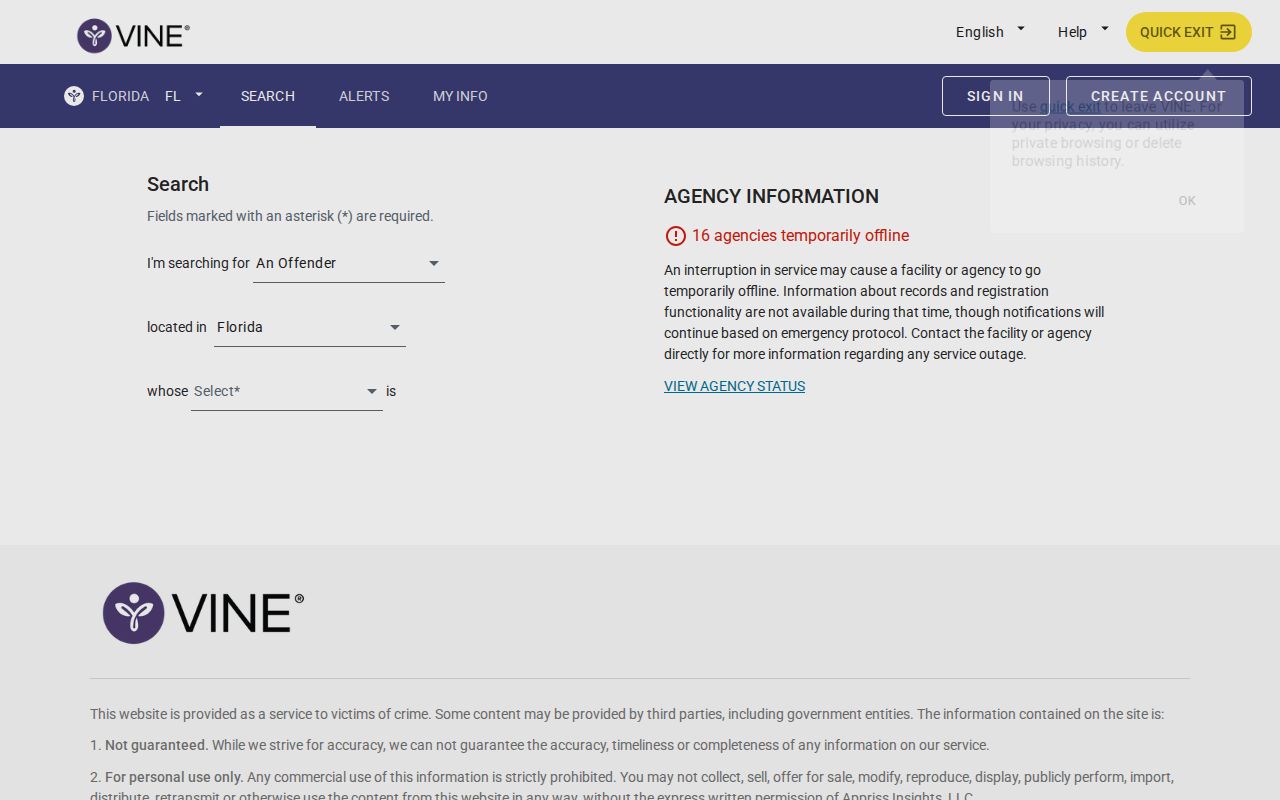
The search screen begins the match, while the opened custody card identifies which agency supplied the status.
Polk VINELink Release Fields
The current card controls which fields appear. Read what is supplied without filling gaps. A Released or Out of Custody status means the reporting custody episode ended. It does not establish bond, time served, dismissal, transfer destination, or the exact time when those facts are absent. Recheck the PCSO booking profile for a county release or FDC offender detail for a state release.
| Field or event | What it supports | What it cannot prove alone |
|---|---|---|
| Name or identifier | Matching the person to a custody card | Identity without comparison to other fields |
| Reporting agency or facility | Whether the card concerns PCSO, FDC, or another source | The person's next destination |
| Custody status | The status sent by that agency | A court disposition or supervision discharge |
| Released or Out of Custody | End of the reported custody episode | Release reason, exact time, or freedom from every hold |
| Transfer | Movement from the reporting location | Community release |
| Release date when supplied | A date tied to the reported event | A future date that cannot change |
For a Polk booking, PCSO's official profile can show Release Date, blank Location, and Inmate Status: Released. The Clerk supplies the case disposition. For state prison, FDC's release detail can show Release Date and Date Out-Custody. Those are the verification records after a VINE alert.
Note: A movement notice can reach the recipient before or after the linked agency's public record refreshes.
Register Polk Release Notifications
Register only after opening the correct person. Button labels can change, but the durable sequence is to choose Notify Me, select a delivery method, review the person and covered events, and confirm. Phone, email, and text may be offered by the current interface. Keep all contact details and the telephone PIN private.
- Choose Notify Me of Status Changes on the matched custody card.
- Select an available phone, email, or text method and enter the destination.
- For telephone alerts, create a four-digit personal identification number that is not easy to guess.
- Review the named person, reporting agency, covered events, and delivery method.
- Confirm the registration. When a call arrives, enter the PIN as directed to acknowledge it and stop repeat calls.
Florida guidance explains that the PIN confirms receipt of a notification call. It is not an offender identifier. General VINELink operator support is available at 1-866-277-7477, and Florida VINE can be reached at 1-877-846-3435. Notification is not guaranteed, so registration should never replace direct verification.
Polk VINELink Limits
VINE is not an all-purpose warrant, case-disposition, or post-release supervision database. Florida training notes that it does not notify for every event, including a violation-of-probation-warrant arrest. It also is not the federal release path. A sentenced federal prisoner belongs in the BOP locator, a federal pretrial detainee may require the U.S. Marshals or federal court, and immigration custody belongs with ICE.
Data can lag, and notification can fail. When a result says Released, note only the event actually shown. Do not supply an unstated reason, destination, or time. For county custody, compare the PCSO booking number, Release Date, status, and court docket. For state custody, compare the DC number, Release Date, Date Out-Custody, and any Supervised Population record.
Telephone checks remain useful while a physical release is being processed. PCSO's current inmate-information number is 863-292-3400. The Sheriff's Releasing Center is 863-534-8712 and sits behind Central County Jail. For FDC release questions, the Bureau of Admission and Release is available at 850-488-9167 or dc.release@fdc.myflorida.com. These offices own the underlying county or state record. VINELink operators can help with alert delivery, but they do not replace the releasing agency's record.
Polk Jail's VINE Entry
PCSO embeds a direct Subscribe to VINE callout inside the same Jail Information Search used to find a booking. This county-local route helps a user move from a record already matched by booking number, date, and status to the statewide alert service. It is more reliable than beginning with a name alone and guessing among similar VINELink cards.
The two systems still have different roles. PCSO maintains the booking profile and release fields. VINE sends an alert based on the data it receives. After a notice arrives, reopen the sheriff profile and verify the Release Date and Released status. If the record suggests transfer to FDC, check the state offender detail rather than assuming the person entered the community.
Note: PCSO's VINE prompt is for a specific inmate, not a complete recent-release feed for Polk County.
Florida Prison VINE Channels
FDC's Victim Notification Request is a distinct state-prison channel. FDC identifies release, transfer, escape, death, and out-to-court as movement events. Providing a direct telephone number through that process automatically registers eligible requesters for VINE calls. A switchboard or call-announcing service can block delivery. FDC Victim Services is available at 1-877-884-2846, Monday through Friday from 8 a.m. to 5 p.m. Eastern.
Direct public VINELink registration does not enroll a person in FDC Victim Services, and the registrations are not shared. FDC frames its separate form for victims, survivors, and representatives. Family or friends who are not victims should use the general VINELink route for a purpose-neutral custody alert rather than submit the wrong state form.
FDC lists release, transfer, escape, death, and out-to-court movement in its notification coverage. Each event must be read by name. Out-to-court means temporary movement for a proceeding, not discharge. Escape is not a lawful release. Death is a custody event but not a release record. The exact event label helps prevent an automated notice from being reduced to the broad claim that the person “got out.”
The official FDC request page shows the movement coverage and Florida contacts:
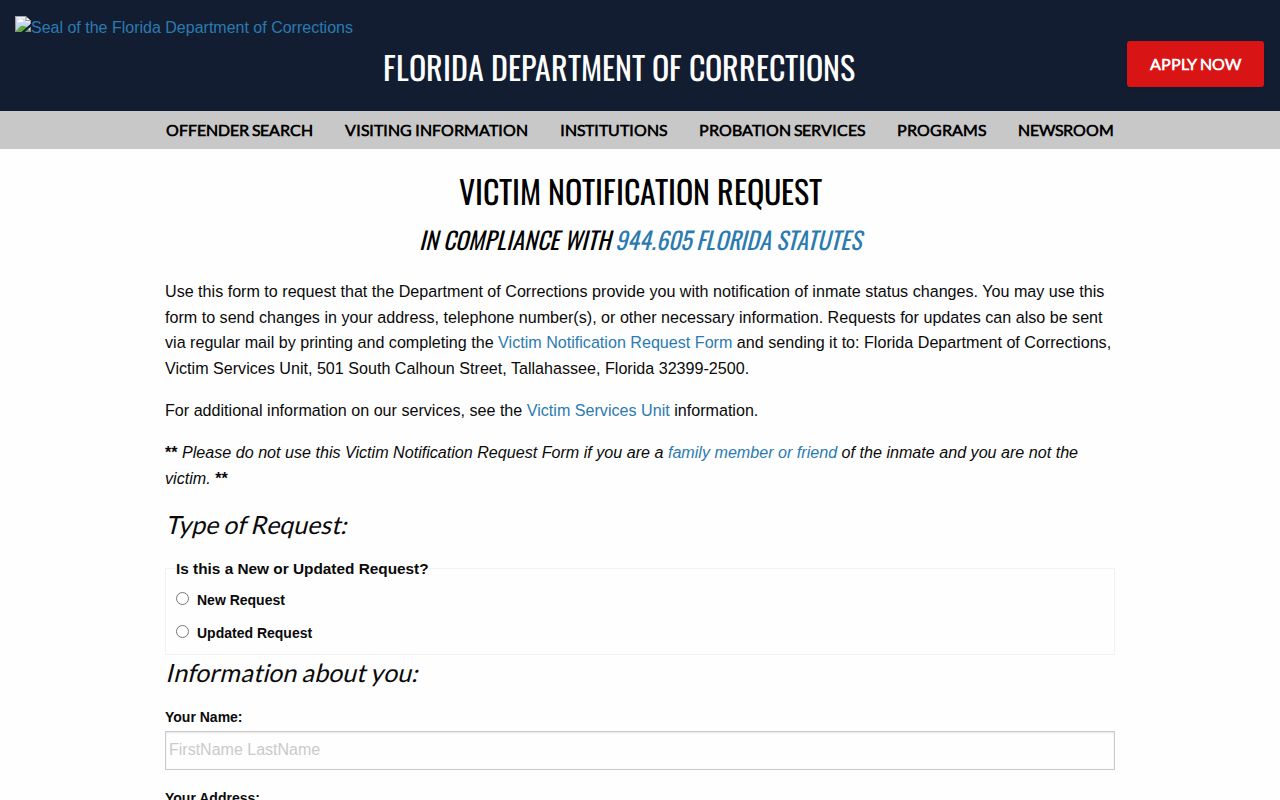
The form supports the state-prison notification layer, while the FDC offender detail remains the record used to verify an actual release.
Polk Release Alerts and Registries
The FDLE Sexual Offenders and Predators Search is a separate post-release source only for people who have a qualifying registration duty. It can show status and registered address information required by law. Its Released status means the person is no longer under listed confinement or supervision while still subject to registry duties. That term is broader than the end of one PCSO booking.
Registry absence says nothing about whether an ordinary Polk detainee was released. Likewise, local address-change alerts are not VINE custody-event alerts. Use VINE for a matched custody event, the registry for a qualifying registration record, and PCSO or FDC for the underlying release. Keeping those channels distinct avoids treating one specialized database as a general inmate locator.
Prospective registration works best while a current custody card is visible. For a release that already occurred, start with the agency's historical record instead. PCSO retains released booking profiles in its name search, while FDC maintains a separate Inmate Release Information database. VINE may help confirm an event notice, but the archived sheriff or corrections detail supplies the fields needed to document the completed custody transition.
Public Record Search
Sponsored Results