
Polk Projected and Actual Dates
A projected date is the agency's current calculation of when a sentenced person may leave custody. FDC labels its public field Current Release Date. Florida Statutes use tentative release date for the gain-time-adjusted calculation and maximum sentence expiration date for the separate sentence endpoint. Those terms should not be merged. A past Release Date and Date Out-Custody in the FDC release record are evidence of an event that occurred, while a Current Release Date remains subject to change.
A pretrial detainee at Central or South County Jail has no computed prison-release date. The next event could be bond, dismissal, a court-ordered release, transfer, sentencing, or continued detention. The Polk Clerk docket and PCSO booking profile are the right records. A state prison inmate at Polk Correctional Institution follows the statewide FDC calculation, even though the institution is located in Polk County.
Find Polk Projected Release Dates
Start with custody type. FDC expressly excludes county-jail-only and county-probation-only records. A person who bonded out of Polk County jail should not be forced into the state prison search. Conversely, a person transferred from PCSO to FDC remains in custody even though the county booking has ended. The Polk County released inmate search explains how to trace that custody change.
- For state prison, open the FDC Inmate Population search. Use the six-character DC number if known, or match name and identifiers.
- Open the correct offender detail. Read Current Release Date and any warning that it is subject to gain-time award, forfeiture, or review.
- If the field says
TO BE SET, wait for FDC review or contact the Bureau of Admission and Release at 850-488-9167 or dc.release@fdc.myflorida.com. - For a Polk jail sentence, obtain the sentencing order from the Clerk and ask PCSO for its existing sentence calculation or release record.
- For a pretrial case, monitor the court docket and jail profile. Do not invent a release date from a hearing date or bond amount.
When an FDC release has already happened, use the Inmate Release Information search. Its detail can show Release Date and incarceration-history Date Out-Custody. A current supervision record may then show parole, conditional release, probation, or another status outside prison.
The FDC database menu separates Inmate Population, Inmate Release, Supervised Population, and Absconder/Fugitive records. For a future date, the population record is the correct channel. For a past event, the release record is stronger. For what followed the prison gate, check supervised population. Search fields include first and last name, aliases, and the six-character DC number. Match race, sex, birth date, photograph, offense county, case number, sentence date, and incarceration history as available. A date attached to the wrong commitment can produce a false answer even when the name matches.
| FDC field | How to read it |
|---|---|
| Current Release Date | FDC's present projection for an active state prisoner |
| TO BE SET | The date awaits establishment after review |
| Release Date | The date shown in population results or a completed release record, depending on database |
| Date Out-Custody | Incarceration-history evidence that the state custody period ended |
| Current Location | The institution or supervision office, not proof of community release by itself |
Florida State Release Computation
Under Florida Statutes section 944.275, FDC establishes the maximum sentence expiration date for a term of years and subtracts lawful credit. It also establishes the tentative release date, which reflects gain time awarded or forfeited. An award or restoration can move that date earlier. A forfeiture can move it later. The tentative date cannot be later than maximum expiration.
For covered offenses committed on or after October 1, 1995, FDC may award up to ten days per month of incentive gain time, subject to offense exclusions. Section 944.275 also prevents gain time from producing release before at least 85 percent of the imposed sentence is served. Court credit for time physically incarcerated counts toward that floor. A mandatory minimum, offense exclusion, or life sentence can sharply limit or eliminate the effect of gain time.
The official gain-time statute displays the tentative-date definition and the statutory floor:
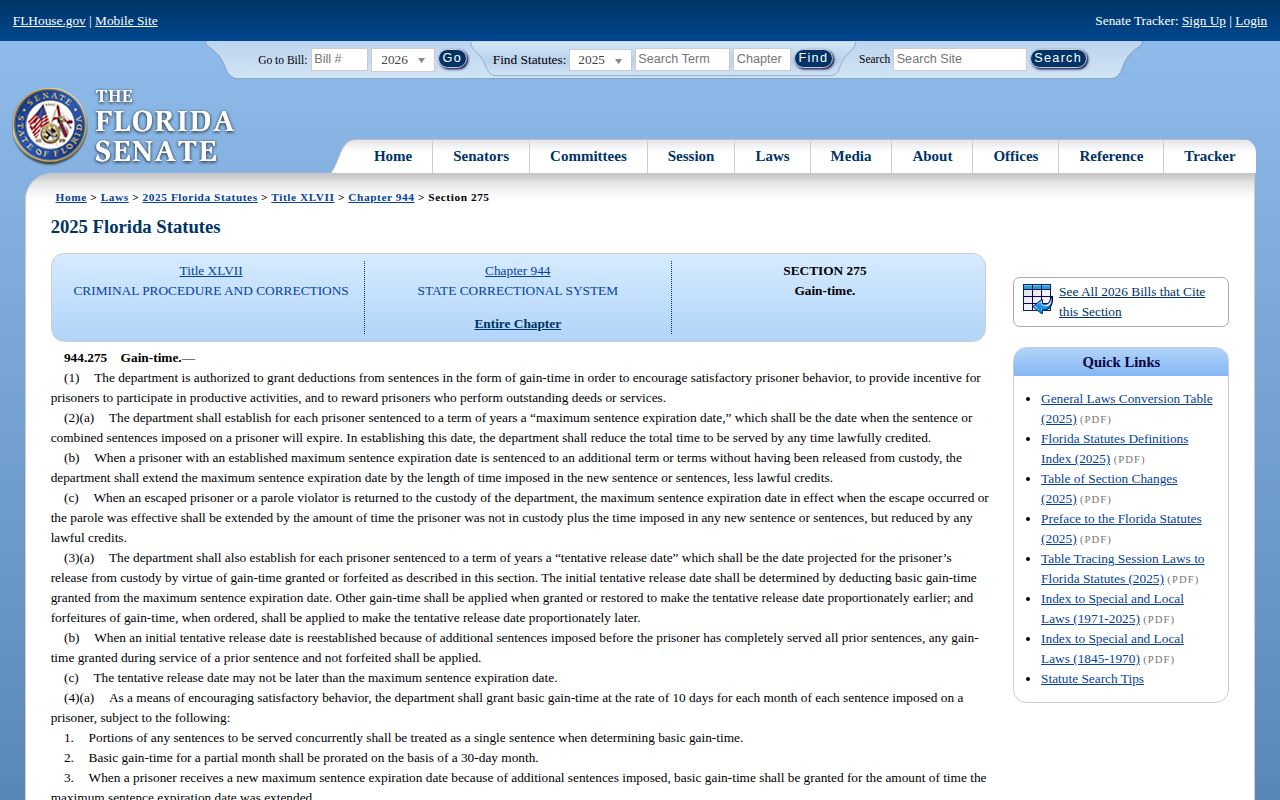
The statute provides the statewide rules, but only FDC's offender record applies those rules to the identified sentence.
Florida's Criminal Punishment Code applies to noncapital felonies committed on or after October 1, 1998. Section 921.002 also states that lawful incentive or meritorious gain time may not reduce time served below 85 percent. It says chapter 947 parole does not apply to people sentenced under that Code. A parole calendar therefore should not be treated as the normal release-date source for a modern Florida prison sentence.
The imposed sentence is only one part of the calculation. FDC begins with the maximum expiration date, applies lawful credit, computes the tentative date, then accounts for eligible gain time and later forfeiture or restoration. Mandatory minimums and offense-based exclusions can constrain the result. The public Current Release Date is the output of that agency work, not a simple subtraction a reader can safely redo from the sentence length.
Note: A life sentence remains life unless pardon or clemency provides a lawful change.
Why Polk Release Dates Move
A release calculation can change after it first appears. FDC warns of gain-time awards, forfeitures, and review on the active detail itself. A later sentence or corrected jail credit can alter the underlying maximum. A detainer is a request or hold from another authority; it may change where the person goes even when one custody term ends. Parole has its own Commission process and should not be assumed from the population page.
Several dates may appear in one case file. The offense date, arrest date, booking date, sentence date, FDC receipt date, current release date, maximum expiration date, and scheduled supervision termination date each describe a different event. The sentence date is not a pickup date. A scheduled supervision end is not the date prison custody ended. A Polk booking Release Date can mark transfer to FDC rather than freedom. Compare the event labels and agencies before deciding which one answers the question.
| Factor | Possible effect | Record to verify |
|---|---|---|
| Gain-time award or restoration | May move the tentative date earlier, subject to the statutory floor | FDC sentence computation |
| Disciplinary forfeiture | May move the current date later | FDC disciplinary and computation records |
| Corrected jail credit | Can change time credited toward the sentence | Sentencing order and FDC calculation |
| New sentence or court order | May extend, reduce, or otherwise change the controlling term | Polk Clerk docket and judgment |
| Detainer or transfer hold | May send the person to another custodian instead of the community | Agency release record and receiving authority |
| FCOR parole action | May establish, delay, modify, or revoke a parole date | FCOR written order |
Confirm Polk Release Dates
The FDC active detail is the clearest public state projection. The official example of that detail shows the exact Current Release Date label:
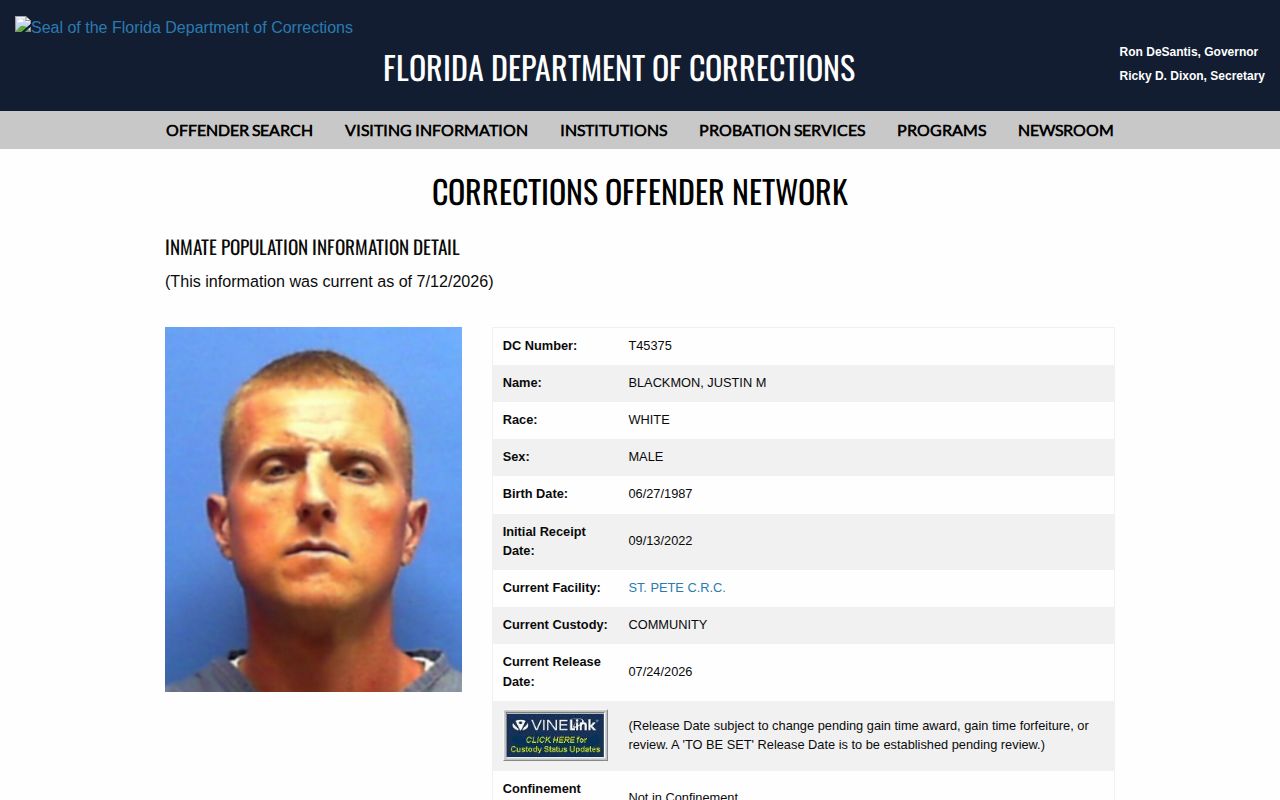
The displayed warning is a reason to recheck close to the date. Population information refreshes weekly, while release dates and location changes update nightly. FDC's separate release search is also updated nightly. A short mismatch between pages can reflect those different update cycles.
For a Polk jail release, call the current inmate-information line at 863-292-3400 or the Sheriff's Releasing Center at 863-534-8712 when departure is in progress. For state prison, contact FDC's Bureau of Admission and Release. A Florida VINELink release alert can prompt a fresh check, but notification is not guaranteed and a transfer alert is not proof of community release.
The Polk Clerk criminal portal supplies the judgment, sentence, dismissal, bond order, or other docket entry that explains why county custody may end. PCSO supplies the booking and release profile. FDC supplies the state calculation after a state commitment. If those records conflict, note when each was refreshed and ask the office that owns the questioned field. FDC says release dates and location changes update nightly, while general population information refreshes weekly. PCSO warns that jail information changes quickly and is updated periodically without promising a minute-by-minute schedule.
For an authoritative old or unclear state record, submit an FDC public-records request for the existing release or discharge documentation, dates in and out, sentence computation, and supervision action. Include the name, aliases, birth date, DC number, conviction county, case number, and approximate date. A focused request helps staff locate the correct commitment and avoids asking the agency to create a new calculation.
Polk County Jail Gain Time
County jail uses a different legal framework. Section 951.21 authorizes county-prisoner good-conduct commutation unless the county commission discontinues or revises it. The statute allows up to five days per month in years one and two, ten in years three and four, and fifteen in year five and later. It also permits an added meritorious allowance of up to five days per month if adopted on the sheriff or warden's recommendation. Misconduct can cause forfeiture.
Those figures are statutory ceilings, not a verified Polk calculation for a named person. No current Polk policy document establishing the exact local award was located in the research. Obtain the sentencing order and the PCSO calculation or release record. Bond, dismissal, court-ordered release, and a time-served judgment are legal events, not gain-time projections.
A felony case also does not always create an FDC date. Section 922.051 permits county jail in specified cases when cumulative terms do not exceed one year. Custody and sentence location must be confirmed first.
Polk Jail Credit to FDC
County-to-state credit can cause a later correction. Section 921.161 requires the sentencing court to specify credit for time spent in county jail before sentence. It also provides credit for the period from sentencing until placement in FDC custody. The local custodian certifies key sentence, delivery, and custody periods.
The computation path is therefore sequential: the court imposes sentence, Polk custody data supports jail credit, FDC sets maximum expiration, and FDC computes its tentative/current release date. Eligible gain time may move the projection earlier. Forfeiture or review may move it later. If a date changes after transfer from PCSO, compare the judgment, certified jail credit, and FDC computation instead of treating the first public date as fixed.
Note: An FDC location change can be a prison transfer and does not, by itself, establish release from state custody.
Public Record Search
Sponsored Results